AI SOLUTION

Enterprise AI Integration

Reference Solution

ENTERPRISE AI INTEGRATION

Bring AI Into the Systems Your Business Already Uses

Enterprise AI delivers the greatest value when it works alongside your existing applications, databases, business processes, and infrastructure.

We design AI integrations that connect intelligent models and automation capabilities with enterprise software, APIs, data platforms, and internal systems—helping organizations introduce AI without unnecessarily replacing the technology they already depend on.

Connected Enterprise AI

AI models, APIs, business applications, databases, and workflows working together.

Enterprise AI Integration

Connect AI With the Technology Your Business Already Runs On

Enterprise AI is most effective when it becomes part of existing business operations rather than operating as an isolated technology.

AI Models

Connect Generative AI, language models, classification systems, extraction models, and other intelligent capabilities to enterprise applications.

Enterprise Applications

Integrate AI with CRM, ERP, internal portals, customer applications, workflow platforms, and other business software.

Data & APIs

Connect databases, APIs, document repositories, knowledge sources, and other enterprise data systems through appropriate integration layers.

The objective is simple: make AI work within your existing technology ecosystem while creating practical business value.

The Integration Challenge

AI Creates More Value When It Can Work Across Your Systems

Many organizations have powerful business applications and valuable data, but AI initiatives can struggle when intelligent capabilities remain disconnected from the systems where business work actually happens.

Disconnected Systems

Business applications, databases, documents, and AI tools may operate independently, making it difficult to move information between them efficiently.

Data Silos

Valuable business information can be distributed across databases, files, applications, and repositories, making consistent AI access and processing more difficult.

Existing Technology Constraints

Organizations often need to introduce AI while preserving existing software, infrastructure, workflows, security controls, and operational processes.

Manual Handoffs

Employees may still need to copy information between systems, manually trigger processes, or move AI-generated results into business applications.

Security & Access

Enterprise AI must account for authentication, authorization, data access, application boundaries, logging, and appropriate security controls.

Scaling AI Across the Business

A successful AI proof of concept may still need reliable integration, monitoring, maintainability, and scalable architecture before it can support broader enterprise use.

Our Approach

Build AI Into Your Existing Business Ecosystem

We design integration layers that connect AI capabilities with the applications, data, APIs, and workflows your organization already depends on.

AI Integration Layer

Connect AI models and intelligent capabilities to enterprise applications through secure, maintainable integration services and APIs.

Enterprise Data Connectivity

Connect AI applications with approved databases, document repositories, knowledge bases, APIs, and other business data sources.

Business Application Integration

Extend existing CRM, ERP, portals, internal applications, and workflow platforms with practical AI capabilities.

Workflow Integration

Connect AI outputs to business workflows so classification, extraction, analysis, routing, and other AI-assisted actions can trigger appropriate next steps.

Security & Access Controls

Design integrations around authentication, authorization, data boundaries, logging, and the security requirements of the surrounding enterprise environment.

Scalable Integration Architecture

Build integration foundations that can evolve as AI use cases expand, new systems are added, and business requirements change.

The goal is not simply to connect an AI model. It is to make AI a useful and maintainable part of the organization's existing technology ecosystem.

Integration Capabilities

Practical AI Integration Capabilities

Connect intelligent capabilities with the systems, data, and processes that support everyday business operations.

API Integration

Connect AI services with internal and external applications through REST APIs and other appropriate integration interfaces.

CRM & ERP Integration

Introduce AI capabilities into CRM, ERP, and other enterprise applications to improve business workflows and decision support.

Database Integration

Connect AI applications with approved enterprise databases and structured business information through controlled application layers.

Document & Knowledge Integration

Connect AI with business documents, knowledge repositories, vector stores, and other approved information sources.

AI-Powered Automation

Combine AI with workflow automation to classify information, extract data, assist decisions, route tasks, and trigger business actions.

Authentication & Security

Support enterprise authentication, authorization, access controls, secure communication, and appropriate application boundaries.

Monitoring & Logging

Provide visibility into integration activity, application events, errors, and AI-powered workflow execution.

Scalable AI Services

Structure AI capabilities as maintainable services that can evolve as new use cases, applications, and business requirements emerge.

Enterprise Architecture

Connect AI Across Your Enterprise Technology Stack

A practical integration architecture allows AI services to communicate with business applications, enterprise data, and operational workflows through controlled integration layers.

Business Applications

CRM, ERP, portals, internal applications, workflow platforms, and customer-facing business systems.

Integration Layer

APIs, services, authentication, business rules, data transformation, routing, and orchestration.

AI Services

Generative AI, language models, document intelligence, classification, extraction, summarization, and intelligent decision support.

Enterprise Data

Databases, documents, knowledge bases, repositories, vector stores, and approved enterprise information sources.
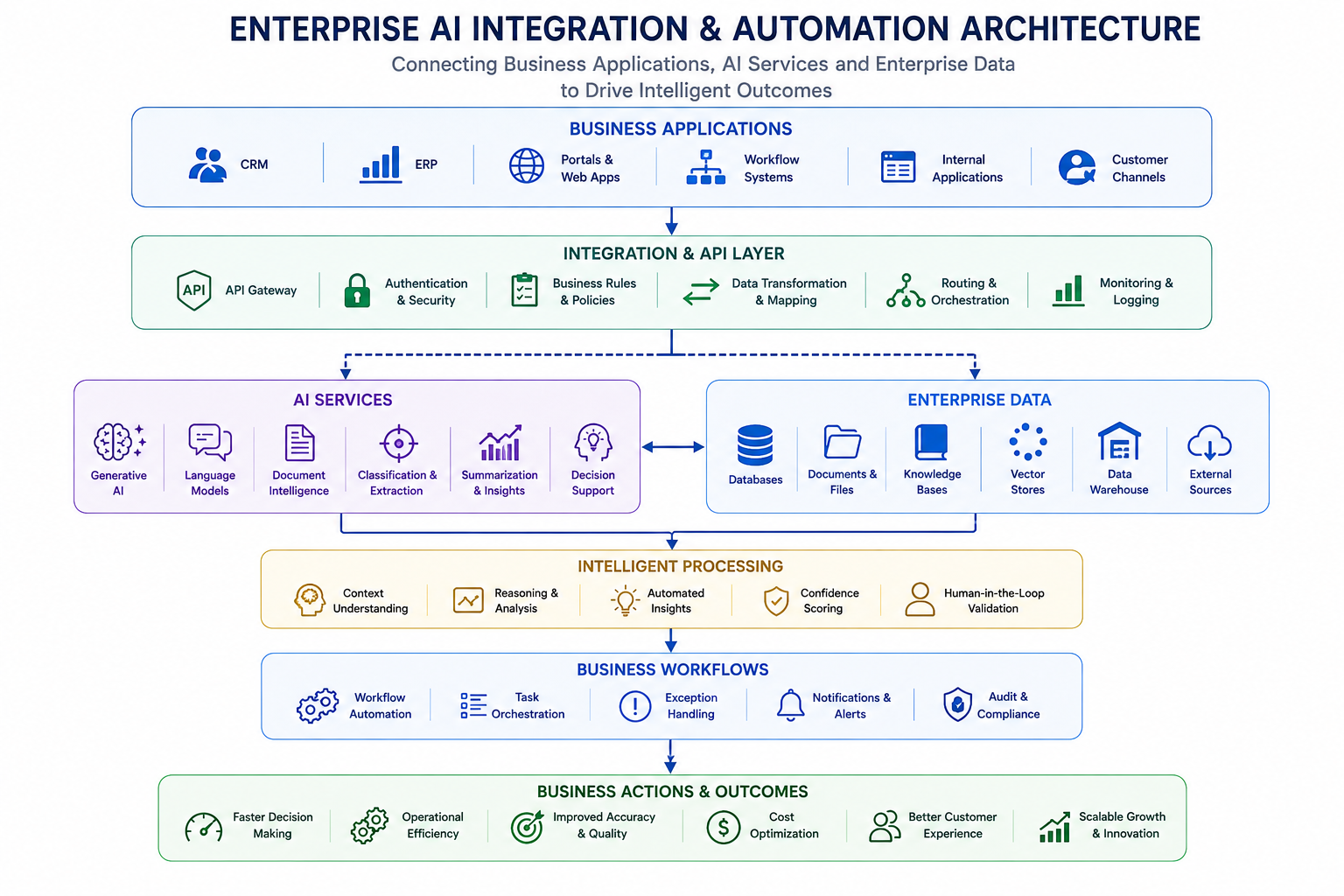
Enterprise AI Integration and Automation architecture connecting business applications, integration services, AI services, enterprise data, and business workflows
Business Benefits

Turn Enterprise AI Into Practical Business Value

Enterprise AI integration is most valuable when it improves existing business processes without creating unnecessary technology complexity.

Faster Business Processes

Connect AI with existing workflows to reduce repetitive manual activities, accelerate information processing, and improve operational efficiency.

Connected Systems

Bring AI capabilities into CRM, ERP, databases, APIs, internal applications, and operational platforms through controlled integration layers.

Better Decision Support

Make relevant business information easier to access, understand, summarize, and act upon using AI-powered analysis and decision support.

Controlled AI Adoption

Introduce AI within defined integration, authentication, access-control, and data boundaries rather than deploying isolated AI tools across the organization.

Scalable Architecture

Build an integration foundation that can accommodate additional AI models, applications, workflows, and data sources as requirements evolve.

Less Technology Disruption

Extend the capabilities of existing technology investments instead of requiring unnecessary replacement of established business systems.

Technology Stack

Built Around Your Existing Technology Environment

Enterprise AI integration can combine modern AI capabilities with the programming languages, frameworks, APIs, databases, and infrastructure already used by your organization.

AI & Language Models

Generative AI, large language models, embeddings, classification, extraction, summarization, and intelligent processing.

OpenAI LLM RAG NLP

Application & Backend

Enterprise application development and integration using established backend technologies and service architectures.

PHP Java Spring Boot REST API

Databases & Data

Structured and unstructured data sources can be connected through secure application and integration layers.

SQL Vector DB Knowledge Base Data APIs

Integration & APIs

Connect AI capabilities with business applications using controlled service and integration interfaces.

REST JSON Webhooks OAuth

Enterprise Platforms

Existing business platforms can remain at the center of operations while AI capabilities are introduced through integration layers.

CRM ERP SaaS Internal Apps

Cloud & Infrastructure

AI services can operate within appropriate cloud or existing infrastructure environments according to business and security requirements.

Cloud APIs Security Monitoring
Industries

Enterprise AI Integration Across Industries

AI integration can be adapted to different business environments, applications, data structures, and operational workflows.

Banking & Financial Services

Connect AI with financial applications, document workflows, customer systems, analytics platforms, and internal operations.

Healthcare

Integrate AI capabilities with healthcare applications, information systems, workflows, and approved data sources.

Manufacturing

Connect AI with production systems, enterprise applications, operational data, quality processes, and supply-chain workflows.

Retail & E-commerce

Integrate AI with customer platforms, product systems, order workflows, support operations, analytics, and business applications.

Professional Services

Connect AI with knowledge systems, client applications, document workflows, internal tools, and operational processes.

Logistics & Supply Chain

Integrate AI with logistics applications, operational workflows, inventory systems, documents, and supply-chain data.

Frequently Asked Questions

Enterprise AI Integration Questions

Common questions about integrating AI with existing enterprise applications, data, and business workflows.

Enterprise AI Integration connects AI models and capabilities with existing business applications, databases, APIs, workflows, and enterprise infrastructure.

No. AI integration is generally designed to work with existing systems wherever practical, allowing organizations to introduce AI without unnecessarily replacing established technology.

Yes. AI solutions can integrate with CRM, ERP, databases, internal applications, APIs, cloud platforms, and other enterprise systems depending on the available interfaces and business requirements.

Yes. AI applications can be connected to structured databases and other data sources through appropriate application and integration layers.

Yes. AI capabilities can be combined with workflow automation to classify information, extract data, make defined decisions, trigger actions, and connect multiple business processes.

Yes. Human review and approval can be incorporated into workflows where business judgment, authorization, exception handling, or additional oversight is required.
START YOUR AI INTEGRATION JOURNEY

Ready to Connect AI With Your Business?

Let's explore how AI can be integrated into your existing applications, data, workflows, and business systems to create practical and measurable value.